



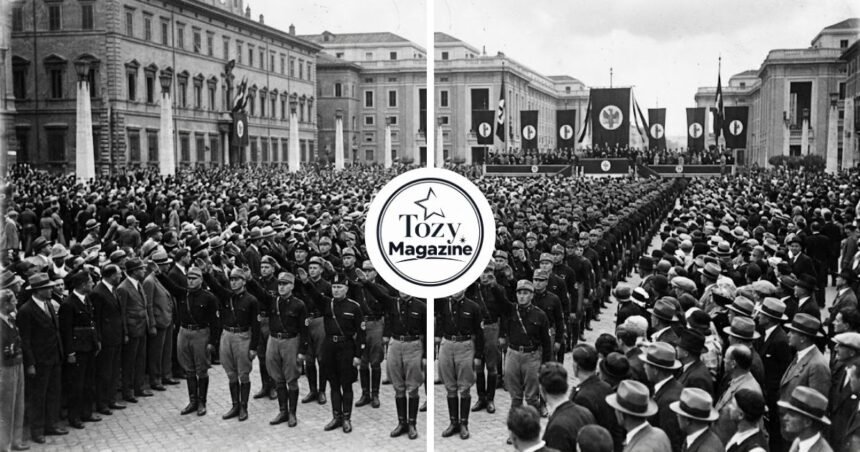
Introduction to the Concept and History of Fascistern
European history in the twentieth century was deeply shaped by radical political movements that challenged democratic systems and reshaped governance across the continent. When exploring Danish political terminology or historical literature, fascisterne refers specifically to “the fascists”—the individuals, political cadres, and organized groups that embraced totalitarian nationalism. Understanding this linguistic and historical term requires looking beyond basic definitions to examine the sociopolitical conditions that allowed authoritarian regimes to rise during the interwar period.
- Introduction to the Concept and History of Fascistern
- Overview of Key Historical Terms and Concepts
- Roots and Origins of Authoritarian Movements
- Core Ideological Pillars and Political Structures
- Propaganda, Media Control, and Mass Mobilization
- Resistance and Counter-Movements Across Europe
- Linguistic Nuances and Context in Modern Usage
- Lessons for Safeguard of Modern Democratic Institutions
- Comparative Analysis of Interwar Movements
- Frequently Asked Questions
- Conclusion
The emergence of these movements coincided with immense global instability following the First World War. Widespread economic disruption, social unrest, and deep-seated fears of political collapse created an environment where radical ideologies promised order and national renewal. Citizens disillusioned with parliamentary impasses turned toward centralized leadership that prioritized state power over individual civil liberties.
Analyzing historical movements provides essential insights into how democratic norms can erode under extreme social pressure. By examining the rise of radical groups across Europe, historians gain a clearer view of the mechanisms used to control public discourse, suppress political opposition, and centralize state authority. This exploration offers crucial lessons about political stability and democratic resilience.
Overview of Key Historical Terms and Concepts
| Term / Concept | Definition & Grammatical Role | Primary Historical Context | Key Characteristics |
| Fascisme | Danish noun for the ideology (“fascism”) | 20th-century European political ideology | Totalitarianism, extreme nationalism, anti-democracy |
| Fascist | Singular noun/adjective (“a fascist”) | Individual supporter or organizational member | Loyalty to absolute state power and central leader |
| Fascisterne | Definite plural noun (“the fascists”) | Historical groups in Italy, Germany, and Occupied Denmark | Organized political units, paramilitaries, state actors |
| Fasci di Combattimento | Italian political organization formed in 1919 | Post-WWI Italy under Benito Mussolini | Paramilitary street violence, extreme nationalism |
Roots and Origins of Authoritarian Movements
The ideological foundation of early twentieth-century authoritarianism grew out of a rejection of enlightenment liberalism and parliamentary governance. Leaders sought to construct a unified corporate state where private interests were entirely subordinated to national goals. The symbolic origins trace back to ancient Roman symbols of collective power and unified authority, which were modernized to appeal to masses recovering from war.
The economic instability of the 1920s and 1930s further accelerated the appeal of non-democratic alternatives. Hyperinflation, mass unemployment, and industrial strife left parliamentary coalitions struggling to maintain public trust. Radical organizers exploited these grievances by offering simple narratives that blamed external enemies, political minorities, and democratic paralysis for national decline.
Through aggressive political campaigning and paramilitary intimidation, these groups systematically dismantled constitutional protections once in power. The centralization of state apparatuses allowed them to control labor unions, educational curricula, and judicial institutions. This historical trajectory illustrates how post-war crises served as a catalyst for transforming fringe political factions into dominant governing regimes.
Core Ideological Pillars and Political Structures
At the heart of fascist ideology lay an uncompromising commitment to ultranationalism and absolute state authority. Unlike traditional conservative or socialist movements, authoritarian statebuilders sought complete social engineering. Individual rights were treated as secondary to the strength, purity, and expansion of the nation-state, creating a society where dissent was viewed as treasonous disloyalty.
Centralized executive power was anchored around a single, undisputed leader who claimed to embody the true will of the people. Decision-making processes bypassed representative parliaments in favor of direct decrees and party hierarchy. Political pluralism was actively dismantled, resulting in single-party states that outlawed rival political organizations and independent trade unions.
To maintain ideological cohesion, state institutions implemented rigorous censorship and state-directed economic planning. Industries were organized into national syndicates aimed at maximizing production for national strength and military readiness. This total integration of social, economic, and political spheres defined the structural reality of these twentieth-century regimes.
Propaganda, Media Control, and Mass Mobilization
Maintaining control required constant public engagement alongside political coercion. Regimes pioneered modern techniques of mass communication, utilizing radio broadcasts, cinematic newsreels, and heavily staged public rallies to shape public opinion. The goal was not merely passive obedience, but active, enthusiastic participation in state-sponsored activities.
Independent journalism was systematically eliminated through state censorship, forced buyouts, and the physical intimidation of editors. State-controlled media organs presented simplified narratives that framed all political issues in binary terms of national survival versus external betrayal. Language was carefully crafted to glorify sacrifice, military discipline, and unquestioning obedience to authority.
Youth organizations were established to indoctrinate younger generations with state ideology before critical thinking skills could fully develop. Physical fitness, military drills, and ideological lectures were woven into daily school routines. This comprehensive approach to media and social control ensured that political doctrine saturated every level of civil society.
Resistance and Counter-Movements Across Europe
The rapid expansion of authoritarian rule sparked diverse forms of opposition across occupied and allied nations. Underground resistance networks emerged to counter state propaganda, sabotage critical infrastructure, and rescue targeted individuals. These groups brought together individuals from disparate political backgrounds, united primarily by their defense of liberty and national independence.
In Northern Europe, including Denmark, civil resistance took both passive and active forms. Illegal printing presses produced underground newspapers to provide accurate news and counter state-sanctioned narratives. Labor strikes, public demonstrations, and intelligence-sharing with Allied forces severely disrupted the operational efficiency of occupying forces and local collaborators.
The courage of resistance fighters highlighted the enduring strength of democratic values even under severe military occupation. Their efforts provided vital support to the broader war effort and laid the moral groundwork for post-war democratic reconstruction. Studying these counter-movements offers essential context regarding how societies fight back against state-sponsored tyranny.
Linguistic Nuances and Context in Modern Usage
In contemporary political discourse, terminology must be used with historical and grammatical precision. In Nordic languages like Danish, understanding the exact grammatical structure prevents confusion between theoretical concepts and specific groups of actors. Recognizing these distinctions allows researchers to analyze historical documents with far greater clarity.
Modern political debates sometimes blur these lines by using historical labels as broad rhetorical insults. Political scientists and historians caution against overusing these terms casually, as misapplication dilutes the specific historical meaning associated with mid-twentieth-century totalitarianism. Precise definitions ensure that critical discussions about governance remain grounded in factual analysis.
Evaluating political language requires paying close attention to historical context, intent, and structural definitions. Whether examining archival records from World War II or reading modern commentary, distinguishing between ideological framework and historic group actors remains essential for rigorous academic analysis.
Lessons for Safeguard of Modern Democratic Institutions
The historical collapse of constitutional democracies in interwar Europe serves as a permanent warning for modern societies. Authoritarian regimes rarely emerge overnight; instead, they often exploit existing legal frameworks to systematically weaken democratic checks and balances from within. Safeguarding civil liberties requires continuous vigilance and active civic participation.
Robust institutional protections—such as an independent judiciary, free press, and secure electoral processes—are critical safeguards against the concentration of power. When these institutions are undermined or delegitimized, democratic societies become increasingly vulnerable to political extremism. Media literacy and critical thinking are equally crucial in countering manipulative propaganda.
Ultimately, protecting open societies depends on a shared commitment to human rights, pluralism, and the rule of law. By studying past political failures, modern citizens gain the tools needed to identify early warning signs of authoritarianism and defend democratic values against contemporary challenges.
Comparative Analysis of Interwar Movements
Comparing the distinct political movements of the 1920s and 1930s reveals important ideological variations. While Italian movements prioritized state supremacy and corporate economic organization, other European variations placed primary emphasis on racial theories and biological determinism. These distinctions affected how each regime managed domestic policy and foreign relations.
Despite these differences, shared operational tactics created a common pattern of governance. All these movements relied on militarized political culture, mass spectacles, violent suppression of political rivals, and absolute loyalty to a central figure. Examining both the similarities and differences provides a nuanced understanding of early twentieth-century totalitarianism.
Understanding these historical distinctions helps scholars differentiate between generalized authoritarianism and specific fascist structures. This analytical clarity remains vital when evaluating historical regimes, post-war reconstruction efforts, and the long-term impact of extreme political doctrines on European society.
Frequently Asked Questions
What does the word fascisterne mean in English?
The term is a Danish definite plural noun that translates directly to “the fascists” in English. It refers specifically to a definite group of people or members belonging to fascist political organizations.
How does fascisterne differ from the word fascisme?
Fascisme refers to the political ideology or system of government itself. In contrast, fascisterne describes the specific individuals, partisans, or historic groups who support and carry out that ideology.
Where did fascist political movements originate?
Modern fascist movements first emerged in Italy following World War I under the leadership of Benito Mussolini. His movement established the political model, symbolism, and administrative techniques that influenced similar groups across Europe during the interwar period.
Why is context important when reading historical terms?
In historical texts, the term refers accurately to specific mid-twentieth-century political groups or wartime occupiers. In modern informal conversation, terms are sometimes used broadly as political insults, making context vital for accurate interpretation.
What were the primary methods used to maintain political control?
Regimes maintained power through a combination of state propaganda, total media censorship, strict legal prohibitions against opposition parties, political violence, and mass youth indoctrination programs.
Conclusion
Examining historical political movements provides essential insights into how extreme ideologies disrupt democratic governance and civil society. In political history, studying terms like fascisterne highlights the crucial role played by specific groups of actors in establishing and maintaining authoritarian power structures. From the rise of interwar regimes in Southern Europe to occupation-era resistance in the North, history illustrates the severe societal costs of unrestrained executive power and the suppression of civil liberties.
Understanding the mechanisms of political control—such as media censorship, aggressive propaganda, and the dismantling of democratic institutions—remains vital for protecting modern constitutional systems. History demonstrates that democratic resilience relies on active civic engagement, independent institutions, and an unwavering commitment to human rights.
Ultimately, analyzing past political failures provides a powerful reminder of the value of open, democratic governance. By maintaining historical awareness and recognizing how authoritarian movements take root, contemporary societies can better protect civil liberties and foster resilient, inclusive communities for the future.