



Introduction
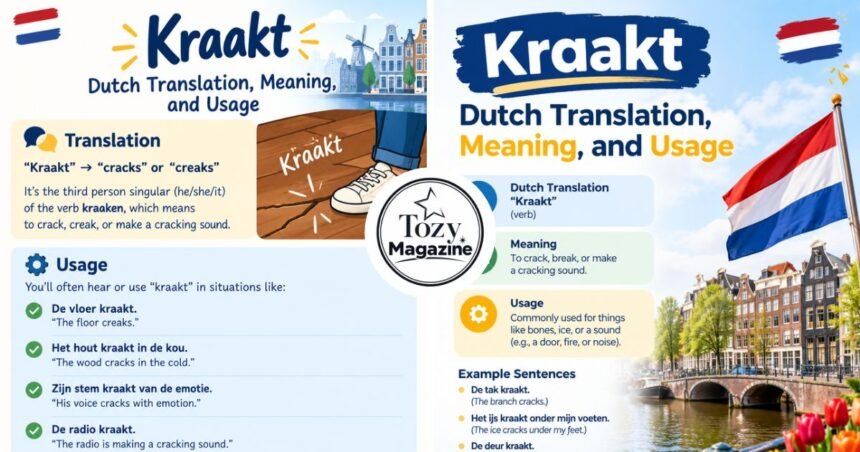
Languages are rich with specific verbs and descriptive terms that capture vivid physical actions and sounds. The word kraakt is a prime example of a expressive term rooted in the Dutch language. Functioning as a conjugated form of the verb kraken, it translates directly to actions like creaking, cracking, crunching, or snapping depending entirely on the surrounding context. From describing an old wooden floorboard echoing underfoot to detailing joint mechanics or figurative idioms, this term serves a wide variety of communicative purposes. Understanding how this verb operates provides valuable insight into Dutch grammar, everyday vernacular, and descriptive sound terminology. This comprehensive article explores the linguistic foundation, varied meanings, everyday applications, and cultural idioms connected to this unique word.
- Introduction
- Core Definitions and Contextual Translations
- Linguistic Roots and Grammatical Structure
- Acoustic Descriptions in Everyday Settings
- Physical Anatomy and Joint Movements
- Material Pressure and Force Dynamics
- Figurative Usage and Cultural Idioms
- Practical Applications and Translations
- Frequently Asked Questions
- Conclusion
Core Definitions and Contextual Translations
| Context / Setting | Primary Action / Meaning | English Equivalent |
| Structural / Wooden Items | Making a high-pitched or strained noise | Creaks / Squeaks |
| Physical Joints / Anatomy | Releasing gas bubbles or joint movement | Cracks / Pops / Crepitus |
| Hard Materials under Pressure | Splitting or fracturing by force | Cracks / Breaks open |
| Idiomatic Expressions | Extreme weather or severe actions | Freezes heavily / Lies blatantly |
Linguistic Roots and Grammatical Structure
From a grammatical perspective, kraakt is the second-person and third-person singular present indicative form of the Dutch infinitive verb kraken. The word features the characteristic long vowel sound typical of Dutch phonetic structures. Linguistically, it belongs to an evocative family of Germanic words that closely mirror the actual physical sound of an action. When conjugated in sentences, it directly describes what a subject is doing at that exact moment. Understanding its placement in present-tense sentences allows non-native speakers and language enthusiasts to grasp how Dutch verbs adapt dynamically to nouns, whether describing an object, a person, or an environmental event.
Acoustic Descriptions in Everyday Settings
In day-to-day conversation, kraakt is most commonly deployed to describe sudden, sharp, or recurring acoustic phenomena. For instance, when stepping on an ancient wooden staircase, a Dutch speaker will note that the floor kraakt under their weight. It is similarly used to describe dry branches snapping underfoot in a dense forest, dry snow crunching under boots during winter, or old doors moving slowly on rusted hinges. The word successfully captures the auditory essence of materials flexing, grinding, or shifting under tension. This rich acoustic versatility makes it an indispensable descriptive verb in creative storytelling and casual everyday dialogue alike.
Physical Anatomy and Joint Movements
Beyond physical structures and objects, kraakt plays an important role in anatomical descriptions and health discussions. Many individuals notice popping or grinding sounds in their knees, fingers, neck, or back during daily activities. In medical terms, this phenomenon is often referred to as crepitus, but in casual conversation, someone might simply say their joint kraakt when bending down or stretching. These sounds frequently stem from harmless gas bubbles popping within joint fluid or tendons gliding smoothly over bony prominences. Recognizing this terminology helps clarify conversations around physical fitness, joint flexibility, and routine body movements.
Material Pressure and Force Dynamics
Another major dimension of kraakt involves physical force, structural pressure, and fracturing objects. When a heavy load is applied to a wooden beam, a ice sheet, or an eggshell, the material begins to yield, making a distinct cracking sound before breaking. In this setting, the verb highlights both the sound produced and the physical act of cracking open under stress. It describes nuts being cracked open with a tool or ice flexing on a frozen lake. This dual focus on sound and structural change gives the word strong narrative power when describing mechanical tension or physical impacts.
Figurative Usage and Cultural Idioms
The term extends beyond literal sounds and physical forces into traditional Dutch idioms and colorful cultural proverbs. For example, the expression “het vriest dat het kraakt” literally translates to “it freezes until it cracks,” meaning it is freezing bitterly cold outside. Another humorous regional idiom, “hij liegt dat het kraakt,” describes someone lying so brazenly that their tall tales seem to creak under the weight of exaggeration. Additionally, traditional sayings like “het slechtste wiel van de wagen kraakt het meest” parallel the English proverb that the squeaky wheel gets the grease. These colorful expressions showcase how deeply embedded the verb is within Dutch cultural storytelling.
Practical Applications and Translations
For translators, language learners, and curious readers, accurately interpreting kraakt requires careful attention to sentence context. Because English uses separate verbs like creak, crack, crunch, pop, or snap for distinct sounds, selecting the right equivalent depends on the object involved. A wooden chair creaks, a dry twig cracks, winter snow crunches, and a knuckle pops—yet all these concepts align under the single Dutch verb form. Mastering these nuances improves cross-cultural communication, allowing writers and translators to maintain natural tone, narrative accuracy, and vivid descriptions across different languages.
Frequently Asked Questions
What language does kraakt originate from?
It is a conjugated present-tense verb form originating from the Dutch language, derived from the infinitive verb kraken.
What are the main English translations for kraakt?
Depending on context, it translates to English verbs such as creaks, cracks, crunch, pops, or breaks open.
Can kraakt be used to describe body movements?
Yes, it is frequently used to describe popping or grinding sounds in joints like knees, fingers, and the neck.
What does “het vriest dat het kraakt” mean?
This popular Dutch idiom means that it is freezing extremely hard outside, referring to the cracking sound of expanding ice.
Is kraakt used for both objects and figurative speech?
Yes, it describes literal physical sounds like creaking floors as well as figurative expressions like blatant lying or severe cold weather.
Conclusion
Exploring the word kraakt provides a fascinating window into descriptive linguistics, physical sound terminology, and cultural idioms. As a versatile form of the verb kraken, it effortlessly bridges physical actions—such as creaking wooden floors, popping joints, and cracking materials—with vibrant figurative expressions. Understanding how the word adapts based on its surrounding context enables clearer translation, deeper language comprehension, and a richer appreciation for Dutch vernacular. Whether applied to everyday household noises, physical wellness discussions, or traditional proverbs, the term remains a powerful, expressive component of descriptive speech.