



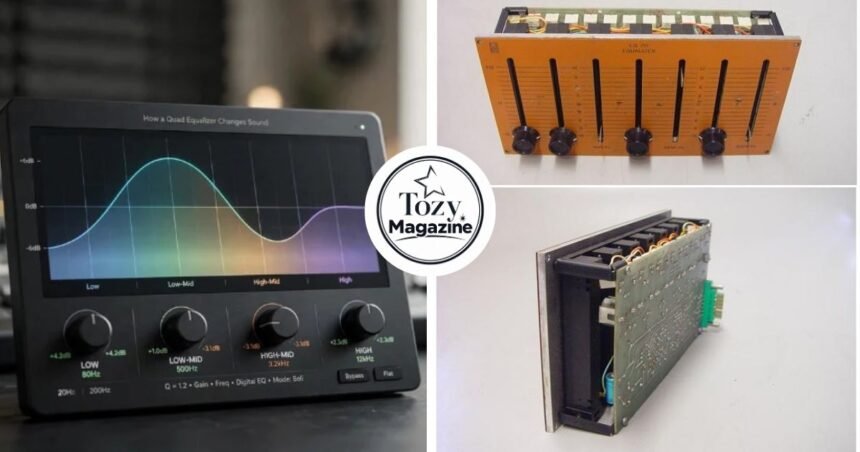
The Appeal of the Quad Equalizer
Audio technology continues to evolve rapidly, yet vintage hardware remains remarkably relevant among dedicated music listeners. While modern setups often lean on digital processing, the physical charm and tactile control of analog components keep audiophiles returning to traditional equipment. Among these classic tools, the four-channel signal processor holds a unique place in hi-fi history. Built to manipulate multi-channel sound fields, it bridges the gap between historical 1970s Quad Equalizer and modern custom listening environments.
- Key Specifications and Functional Summary
- The Core Mechanics of Four-Channel Frequency Tuning
- The Evolution from Stereo to Quad Equalizer Immersion
- Acoustic Dynamics and the Role of Room Reflections
- Step-by-Step Calibration Strategy for Clean Sound
- Comparing Vintage Hardware to Modern Digital Signal Processing
- Frequently Asked Questions
- Elevating Your Audio Setup with Analog Precision
Unlike standard two-channel units designed strictly for stereo left and right signals, a quad equalizer manages four independent sound paths: front-left, front-right, rear-left, and rear-right. By altering specific frequency bands across four distinct channels, listeners gain direct influence over their acoustic surroundings. Whether compensating for room reflection or matching different speaker pairs, this hardware offers a hands-on method for refining sound that software menus rarely replicate.
Key Specifications and Functional Summary
| Feature Category | Technical & Operational Details |
| Channel Architecture | 4 Independent Channels (Front Left/Right, Rear Left/Right) |
| Primary Era | 1970s Quadraphonic & Vintage Hi-Fi Movement |
| Control Interface | Physical Sliders / Potentiometers per Frequency Band |
| Signal Placement | In-line via Tape Monitor Loop or Pre-Out/Main-In |
| Main Objective | Channel-Specific Frequency Correction & Acoustic Balancing |
| Bypass Mode | Direct Signal Hardware Switch for A/B Listening Comparisons |
The Core Mechanics of Four-Channel Frequency Tuning
An audio equalizer alters the relative amplitude of specific frequency ranges without creating entirely new musical elements or repairing damaged recordings. It divides the audible spectrum into bands—typically low-frequency bass, mid-range, and high-frequency treble—allowing targeted adjustments. When all controls rest in their center detent, the output maintains a neutral or flat response. Moving a slider upward boosts that band, whereas sliding it downward attenuates it.
Operating four discrete channels adds a essential dimension to this process. Front speakers often face different acoustic conditions than rear speakers due to room layout, furniture, or wall distance. A quad equalizer enables independent frequency sculpting for front and rear pairs. This ensures that lower bass frequencies or high-end cymbals match smoothly across the entire room rather than overwhelming one side.
The Evolution from Stereo to Quad Equalizer Immersion
Audio recording initially relied on monophonic sound before stereo revolutionized home listening by creating a spatial left-to-right soundstage. During the 1970s, equipment manufacturers pushed spatial audio further by introducing quadraphonic formats. By positioning four speakers around the listener, engineers sought to wrap the audience in a 360-degree sonic environment rather than projecting sound from a single directional plane.
While Quad Equalizer faced commercial challenges due to competing format standards and high equipment costs, the movement laid the foundation for modern surround sound systems. Four-channel signal controls became critical components of these setups. Because listening rooms were rarely symmetrical, adjusting individual speaker outputs allowed users to correct spatial imbalance, establishing sound field principles still utilized in contemporary audio engineering today.
Acoustic Dynamics and the Role of Room Reflections
Listening spaces dramatically alter how speakers perform, meaning identical audio gear can sound brilliant in one room and boomy or harsh in another. Hard surfaces like glass windows, hardwood floors, and bare walls reflect sound waves, creating sharp high-frequency glares. Conversely, plush sofas, thick carpets, and heavy drapes absorb higher frequencies, leaving the overall audio feeling muffled or dark.
Speaker placement near corners or rear walls naturally accentuates low-frequency bass, often making rear channels sound heavier than the front pair. Simply adjusting the master volume cannot fix these localized frequency spikes. By using fine-tuned adjustments on a multi-channel unit, listeners can gently notch out troublesome room resonances, restoring vocal clarity in the mid-range and establishing balanced output across all four listening corners.
Step-by-Step Calibration Strategy for Clean Sound
Proper calibration begins with physical room adjustments before touching any electronic slider controls. Position your primary front and rear speakers equidistant from your central listening chair whenever possible. Once physical placement is optimized, connect the unit to your receiver using four-channel tape monitor loops or pre-out/main-in connections to ensure clean signal routing.
[Audio Source] ──> [Receiver / Pre-Amp] ──(Tape Out)──> [Quad Equalizer]
                                                               │
[4-Channel Speakers] <──(Main Amplification) <──(Tape In)──────┘
Set every slider to its flat, zero position and choose a well-mastered, familiar reference track featuring natural acoustic instruments and clear vocals. Listen critically from your main seat, making subtle adjustments to one frequency band at a time. Use the unit’s bypass switch frequently to compare your customized settings against the original unadjusted signal, preventing accidental over-processing or artificial sound distortion.
Comparing Vintage Hardware to Modern Digital Signal Processing
Modern digital receivers utilize software algorithms and microphone-based calibration to analyze room acoustics automatically. These digital signal processors offer incredible surgical precision, allowing narrow notch filters that analog gear cannot easily match. Furthermore, digital systems eliminate the potential circuit noise or component degradation associated with aging physical hardware.
Despite digital advancements, vintage physical equipment provides an tactile, immediate connection to the music playback process. Adjusting real potentiometers offers instant physical feedback without navigating multi-tiered screen menus. For vintage hi-fi enthusiasts, the glowing displays, brushed metal faceplates, and hands-on responsiveness of analog gear offer an authentic listening ritual that software solutions simply cannot duplicate.
Frequently Asked Questions
What is the main purpose of a quad equalizer?
It adjusts specific frequency bands across four separate audio channels, allowing users to balance sound levels between front and rear speaker pairs while correcting room acoustics.
Can this equipment restore poorly recorded or damaged audio files?
No, equalization only adjusts the volume balance of existing frequencies; it cannot add missing musical detail or eliminate heavy background distortion.
How do I properly connect a 4-channel unit to my vintage receiver?
Connect the processor through the 4-channel tape monitor loop or pre-amp output/input jacks using shielded RCA cables for clear signal transfer.
Should I push all the sliders up to make the music sound fuller?
No, raising every slider boosts overall output gain, which frequently introduces signal distortion. It is far more effective to cut problematic frequencies gradually.
What should I check before purchasing a vintage 4-channel unit?
Test every channel and slider for static noise, verify that all input/output jacks function cleanly, and ensure internal components show no signs of severe aging or signal hum.
Elevating Your Audio Setup with Analog Precision
The enduring popularity of multi-channel analog gear proves that thoughtful sound shaping never goes out of style. While digital correction dominates modern consumer electronics, physical frequency sculpting offers unmatched hands-on control over your personal listening space. Understanding how room reflections, speaker positions, and frequency bands interact allows you to extract the best possible performance from your sound system.
By taking a restrained approach—making small, deliberate adjustments rather than extreme visual slider patterns—you can achieve a transparent, immersive soundstage. Whether restoring classic Quad Equalizer gear or optimizing a custom four-speaker listening room, a well-calibrated setup remains a powerful asset for any serious music enthusiast.
Explore Exciting Content, Discover Something New: Who Is Jodi Lynn Calaway? Inside The Undertaker’s First Marriage