



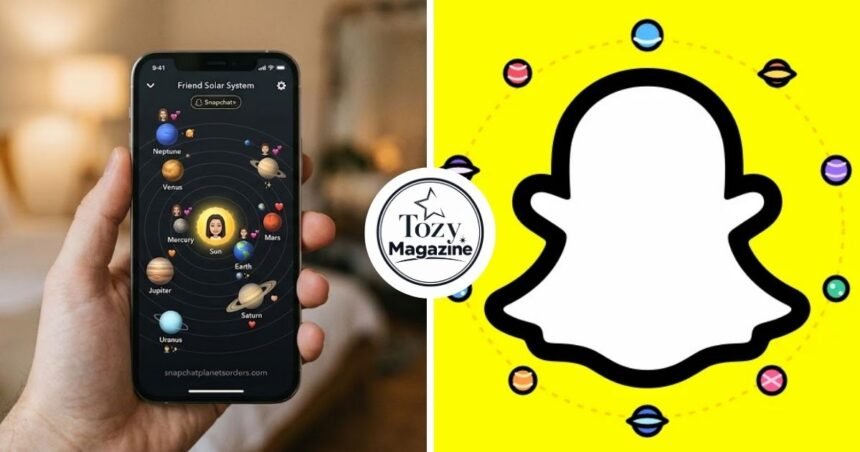
The Snapchat Solar System and Friend Rankings
Snapchat transformed how users track their digital friendships by introducing the Friend Solar System, an exclusive feature for Snapchat+ subscribers. Instead of relying on traditional text-based lists, this visual system organizes your top eight contacts into a digital galaxy. In this dynamic universe, you sit at the center as the Sun, while your closest friends orbit around you as distinct celestial bodies. The placement of each contact depends entirely on mutual engagement, communication consistency, and private interaction algorithms.
- The Snapchat Solar System and Friend Rankings
- Quick Overview: Snapchat Planets Order and Meanings
- Deciphering the Inner Orbit: Mercury, Venus, Earth, and Mars
- Exploring the Outer Limits: Jupiter, Saturn, Uranus, and Neptune
- How Interaction Algorithms Calculate Friendship Tiers
- Why Planet Positions Change and How to Manage Shifts
- Viewing Your Position in Another User’s Universe
- Key Visual Indicators and Emoji Design Differences
- Practical Value and User Privacy Considerations
- Frequently Asked Questions
- Conclusion
Navigating snapchatplanetsorders.com helps users break down how these cosmic tiers work in everyday app usage. The feature translates complex interaction metrics—including daily Snap exchanges, direct messages, and continuous snapchatplanetsorders.com—into an easy-to-understand visual hierarchy. Because the system evaluates engagement on a rolling basis, friend placements naturally shift over time as your messaging habits change. Understanding this structure allows users to interpret their relative positions within their social circles without confusion or guesswork.
Quick Overview: Snapchat Planets Order and Meanings
| Planet Order | Associated Rank | Visual Description | Primary Meaning |
| Mercury | #1 Best Friend | Red planet surrounded by red hearts | Top contact with the highest interaction frequency. |
| Venus | #2 Best Friend | Light brown planet with multicolored hearts | Extremely strong bond, second only to Mercury. |
| Earth | #3 Best Friend | Blue and green sphere with moon and red hearts | Reliable, frequent communication on a weekly basis. |
| Mars | #4 Best Friend | Reddish sphere with purple and blue hearts | Active friendship with regular Snap exchanges. |
| Jupiter | #5 Best Friend | Orange striped planet with surrounding stars | Steady contact with moderate daily engagement. |
| Saturn | #6 Best Friend | Yellow-orange planet with a prominent ring | Consistent friend with moderate conversation depth. |
| Uranus | #7 Best Friend | Solid green planet without hearts | Casual interaction tier among your top contacts. |
| Neptune | #8 Best Friend | Deep blue planet representing distant orbit | Lowest interaction volume among the top eight list. |
Deciphering the Inner Orbit: Mercury, Venus, Earth, and Mars
The inner orbit represents your primary core of friends on the platform. Mercury claims the closest position to the Sun, signifying your absolute number one best friend. This placement requires continuous, two-way communication, long-term snapchatplanetsorders.com, and heavy daily interaction. Venus follows closely in second place, representing a friend who shares an nearly identical volume of messages but falls slightly behind your top spot.
Earth and Mars occupy the remaining positions in the inner circle. Earth marks your third closest contact, characterized by consistent photo sharing and active story replies throughout the week. Mars holds the fourth spot, often acting as a bridge between your core inner circle and outer connections. Friends in the Mars position typically exchange daily Snaps but may engage in fewer extended text or video conversations compared to those in the top three positions.
Exploring the Outer Limits: Jupiter, Saturn, Uranus, and Neptune
The outer region of the Friend Solar System accommodates contacts who maintain steady engagement without high-volume daily activity. Jupiter takes the fifth position, represented by its distinctive orange stripes. This tier reflects a solid friendship where interactions occur regularly, though perhaps less intensely than inner-circle conversations. It often highlights long-term friends who stay in touch through periodic check-ins.
Saturn, Uranus, and Neptune complete the outer boundary of your top eight contacts. Saturn holds the sixth spot, featuring its signature cosmic rings to denote steady, mid-level engagement. Uranus sits in seventh place with a clean green appearance, representing casual communication patterns. Finally, Neptune sits at the eighth spot as the farthest planet. While still recognized within your top eight, Neptune indicates the lowest relative interaction volume among your primary friend group.
How Interaction Algorithms Calculate Friendship Tiers
snapchatplanetsorders.com calculates planet assignments using an automated background algorithm rather than static contact lists. The algorithm measures several core parameters to establish ranking positions accurately. Reciprocal interaction carries the heaviest weight; sending unanswered Snaps contributes significantly less than balanced, back-and-forth exchanges. The platform analyzes communication over rolling multi-day windows to reflect active relationship dynamics.
Key metrics tracked by the system include:
-
Snap Frequency: Total volume of photos and videos sent and received mutually.
-
Chat Consistency: The regularity of text messages exchanged in direct conversations.
-
Story Engagement: Responses, replies, and reactions generated from posted stories.
-
Voice and Video Calls: Active call duration completed within the application interface.
Why Planet Positions Change and How to Manage Shifts
It is completely normal for positions within the Friend Solar System to fluctuate over time. Because rankings are relative, a change in communication with one contact directly impacts the relative positioning of others. For example, if you enter an active messaging phase with a friend on Saturn, they may rapidly advance to Earth or Venus, causing other friends to shift outward toward Uranus or Neptune.
Understanding these dynamics helps users maintain realistic expectations about digital rankings. Fluctuations do not necessarily indicate a decline in real-world friendships; rather, they simply reflect short-term variations in app usage. Users seeking to maintain specific placements should focus on consistent, daily two-way communication rather than periodic, high-volume messaging bursts.
Viewing Your Position in Another User’s Universe
Checking your placement in a friend’s solar system requires a simple, straightforward navigation process within the app. First, ensure you have an active Snapchat+ subscription enabled on your account. Navigate to your target contact’s profile page and locate the friendship badge beneath their Bitmoji avatar. Tapping this badge reveals your assigned planet within their personal universe, showing precisely where you rank in their top eight list.
If the badge displays Best Friends, both users rank within each other’s top eight categories. If it displays Friends, you hold a top-eight spot in their solar system, but they do not currently sit within yours. It is important to note that solar system arrangements are asymmetric; your position in someone else’s system can differ entirely from their position in yours due to differing overall communication habits.
Key Visual Indicators and Emoji Design Differences
Each planet features distinct visual elements designed to make identification immediate and intuitive. Snapchat incorporates specific color palettes, floating hearts, stars, and planetary rings to differentiate the eight tiers. Recognizing these artistic cues allows users to identify rankings instantly without reading detailed profile text.
-
Heart Embellishments: Inner planets like Mercury, Venus, Earth, and Mars feature surrounding hearts in various shades, indicating higher interaction intensity.
-
Ring Structures: Saturn is distinguished by its golden orbital ring, making it visually unique among the outer tiers.
-
Clean Spheres: Uranus and Neptune present minimalist, solid-color designs with fewer decorative overlays, symbolizing more casual contact tiers.
Practical Value and User Privacy Considerations
While the Friend Solar System offers an engaging visual experience, Snapchat designed the feature with essential privacy protections. Your complete solar system layout remains entirely private to your account. Other users cannot view your full top eight list or see how your other contacts are ordered. A friend can only view their own individual placement when checking your profile badge.
This design balances friendly competition with user privacy, preventing public broadcasts of private communication habits. For users who prefer not to participate in ranking systems, Snapchat allows subscribers to toggle the Friend Solar System feature on or off within their Snapchat+ settings menu. This flexibility ensures users can enjoy subscription benefits while maintaining control over their personal profile experience.
Frequently Asked Questions
Who can see my snapchatplanetsorders.com Friend Solar System?
Your full solar system layout is completely private to you. Other users can only see their own individual planet placement when they view your profile badge, provided both accounts meet the feature requirements.
Do I need Snapchat+ to access planet rankings?
Yes, the Friend Solar System is an exclusive feature reserved for active Snapchat+ subscribers. Free accounts cannot view planet badges or access solar system ranking animations.
Why did my friend drop from Mercury to a lower planet?
Planet assignments update continuously based on recent messaging patterns. If your direct messages, Snaps, or streak activity with another contact exceed interactions with your Mercury friend, the rankings automatically adjust.
Does sending streaks affect planet placements?
Maintaining daily snapchatplanetsorders.com positively impacts ranking calculations because it ensures consistent two-way communication. However, combined text chats, story replies, and calls also weigh heavily into the final algorithm.
Can I turn off the planet feature on my account?
Yes, Snapchat+ subscribers can easily disable or re-enable the Friend Solar System through the Snapchat+ management settings screen without losing their active subscription benefits.
Conclusion
The snapchatplanetsorders.com Friend Solar System redefines how users visualize their digital connections by combining astronomy-themed artwork with intelligent interaction tracking. By converting complex messaging data into eight distinct planetary tiers—spanning from Mercury down to Neptune—the platform offers subscribers an intuitive snapshot of their closest relationships. The inner planets highlight your most active, daily conversations, while the outer spheres represent steady, valued contacts who interact less frequently.
Understanding the underlying mechanics of these cosmic rankings removes the mystery behind shifting badges and shifting placements. Because the algorithm prioritizes continuous, mutual engagement over one-sided messaging, maintaining your desired positions relies on balanced daily communication. Whether you use the feature to monitor your top snapchatplanetsorders.com or simply enjoy the visual design, the solar system provides a unique, private way to explore your social circle.